Juliana Paek: Rust of Diaspora
Between Becoming and Disintegration
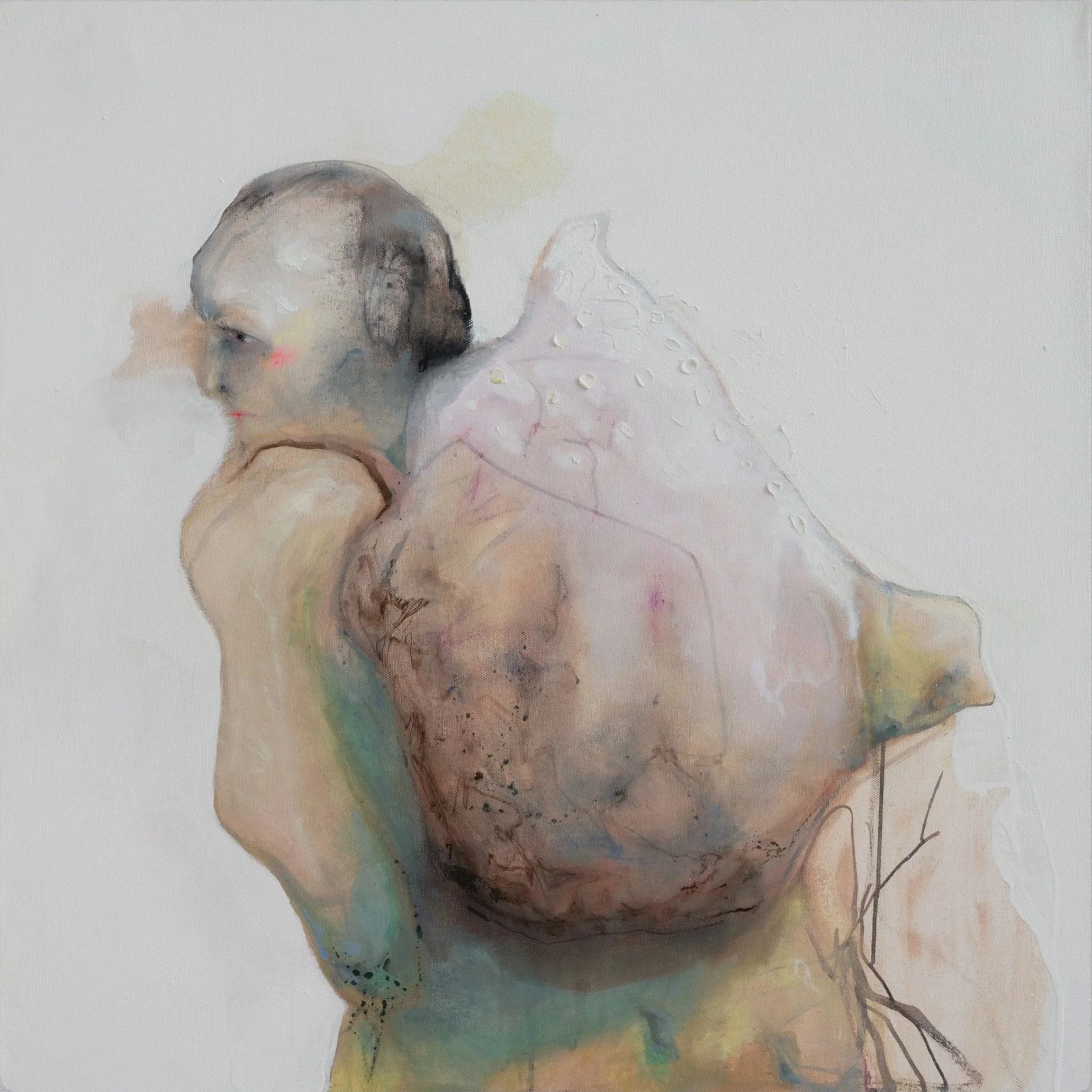
Sisyphos, 2025, oil on canvas, steel, 86 × 86 cm
Juliana Paek (b. 1997, Düsseldorf) is a German artist of Korean descent currently studying at the Kunstakademie Düsseldorf.
Working across painting, sculpture, and installation, Paek often takes how bodily experience is produced and interpreted as her point of departure. She interrogates issues of identity, nationality, and belonging that shape an entire generation, as well as the continuously evolving relationship between society and technology.
Having received a systematic philosophical education during her undergraduate studies, Paek often builds rigorous conceptual genealogies behind her works. The body in her images rarely appears in complete form; it is more like a structure generated through processing. These figures do not point to specific individuals but come closer to a state of embodiment—shaped by familial relations, disciplined by social norms, and continually eroded and rewritten by technology and time, endlessly merging, dislocating, and deforming.
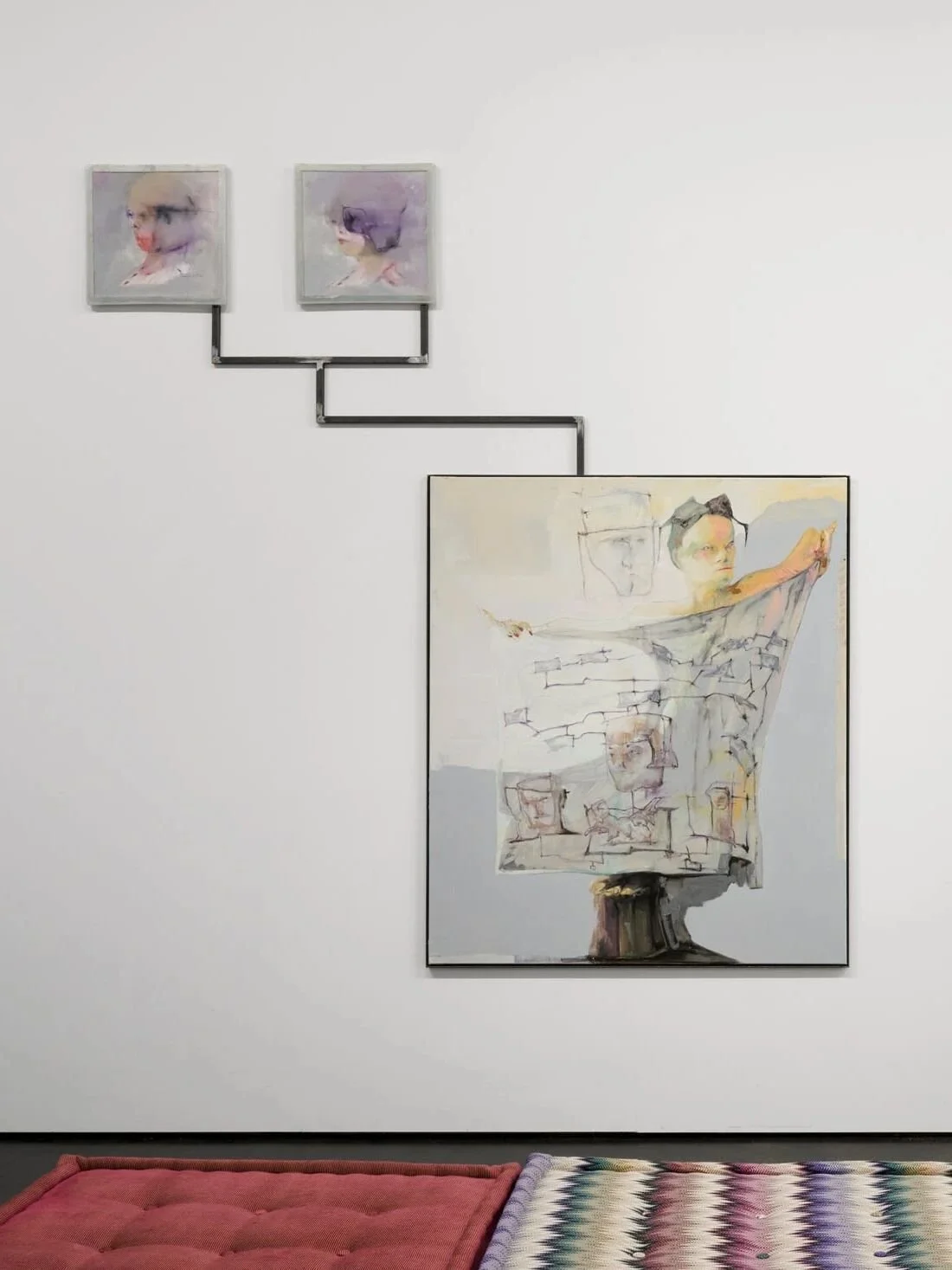
Originating from her recent in-depth research into clan structures and genealogy, she uses “Jokbo” (족보, traditional Korean family genealogies) to explore familial bloodlines. Genealogies focus on paternal families and trace male descendants through the generations, while women are often overlooked or mentioned only in passing. This left her, having grown up in the West, feeling profoundly fractured, and inspired her desire to create a “counter-archive” and personal mythology. She reexamines neglected female narratives within family structures and responds to the mechanisms by which identity is produced through the form of the “mask.”
Jokbo/Family Tree No. 3, Diagrammatical Ancestry: the veil of vero,2025, Oil on canvas, metal, fiberglass, 230 × 230 cm
Courtesy of ©Mareike Tocha, Cologne and ©Braunsfelder, Cologne
In Paek’s artistic language, the face is no longer an individual characteristic but rather a structure that is inherited and even replaced. Identity is never naturally given; it is continuously shaped and distorted within cultural and power structures. The body is no longer a stable subject but something like an interface that is constantly rewritten, always between becoming and disintegration—an existence that can neither fully become “human” nor completely transform into “other.”
When identity is stripped away and the self gradually dissolves, we encounter another strand of Paek’s practice: she presents dystopian yet realist future scenarios, focusing on posthumanist discourse and reflections on Asian culture—beginning with the endless repetition implied by neoliberalism: wake up, work, socialize, achieve goals.
This echoes techno-orientalism’s depiction of East Asia as a cold, high-tech, impersonal future, much like what Byung-Chul Han seeks to convey in The Burnout Society: people lose themselves in self-exploitation in pursuit of achievement, ultimately leading to mental collapse and emptiness, because neuronal decline is not only physiological pathology but also a social burnout caused by overproduction and overconsumption.
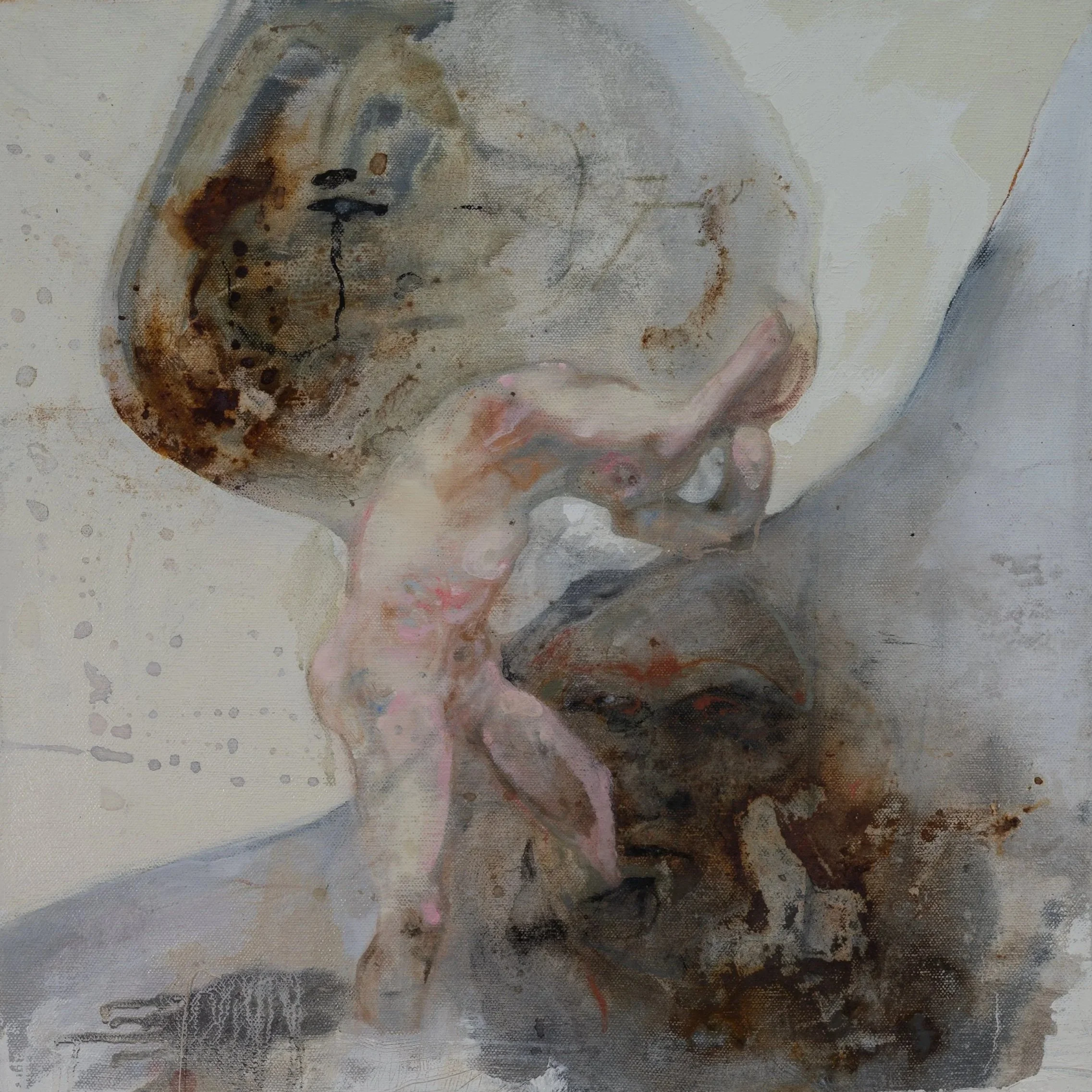
The journey is long and dreary, bones are cracking, 2025, Oil on canvas, rust, 60 × 60 cm
Paek integrates rust into her oil paintings, using the material’s decay as a visual metaphor, symbolizing how even the most enduring structures—whether physical matter or deeply rooted social habits—eventually dissolve. Through chemical treatment of the canvas, she allows it to oxidize and rust naturally over time, combining adhesives to build thick surfaces. The originally flat painting thus acquires a volume close to relief, representing a process of structural loosening, form spiraling out of control, and identity gradually disintegrating.
In the works exhibited at this year’s Rundgang, the front is an abstract human figure generated by rust, while the back incorporates the 3D-printed mask Bune – Mask: Genealogies of Distortion. The whole is fixed within an iron frame and can be viewed from both sides. Painting, sculpture, and installation are no longer parallel media here but are integrated into a single “body”: the front is an image in the process of becoming, the back a face that has been solidified.
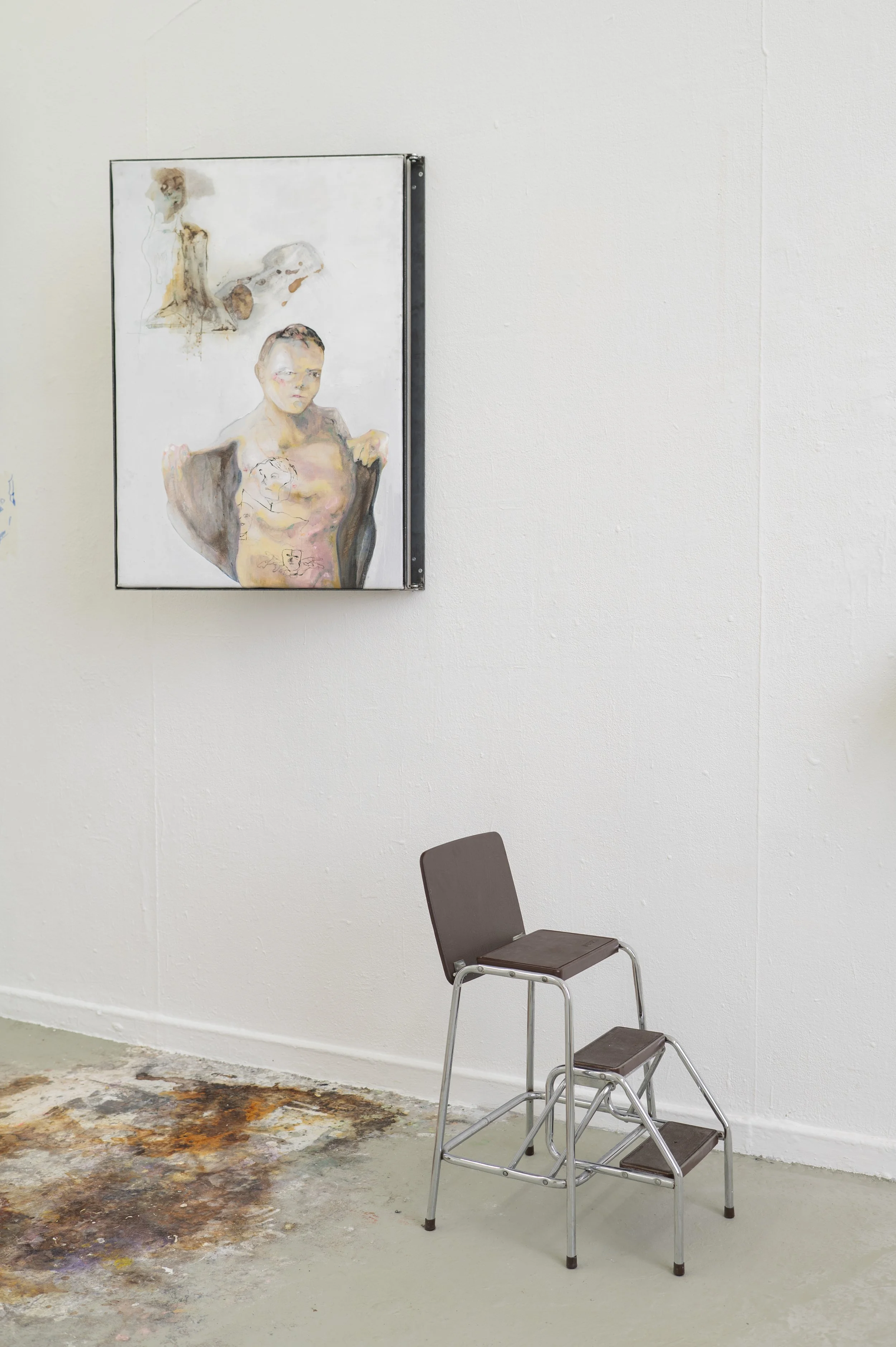
Death of the Self, 2026, Oil on canvas, rust, metal frame, colored mask (artificially aged), step stool, 110 × 76 cm
Paek finds many outlets in Eastern philosophy: imperfection and decay echo the wabi-sabi aesthetic’s appreciation of impermanence, decline, and imperfection, forming a strong opposition to industrial society’s pursuit of “eternity, flawlessness, and standardization”; Zen Buddhism’s nirvana and “emptiness” offer new solace for the loss of identity and existence, reconstructing the order of biopolitics and thus generating the possibility, amid fragments, of rethinking new forms of existence and ways of living together.
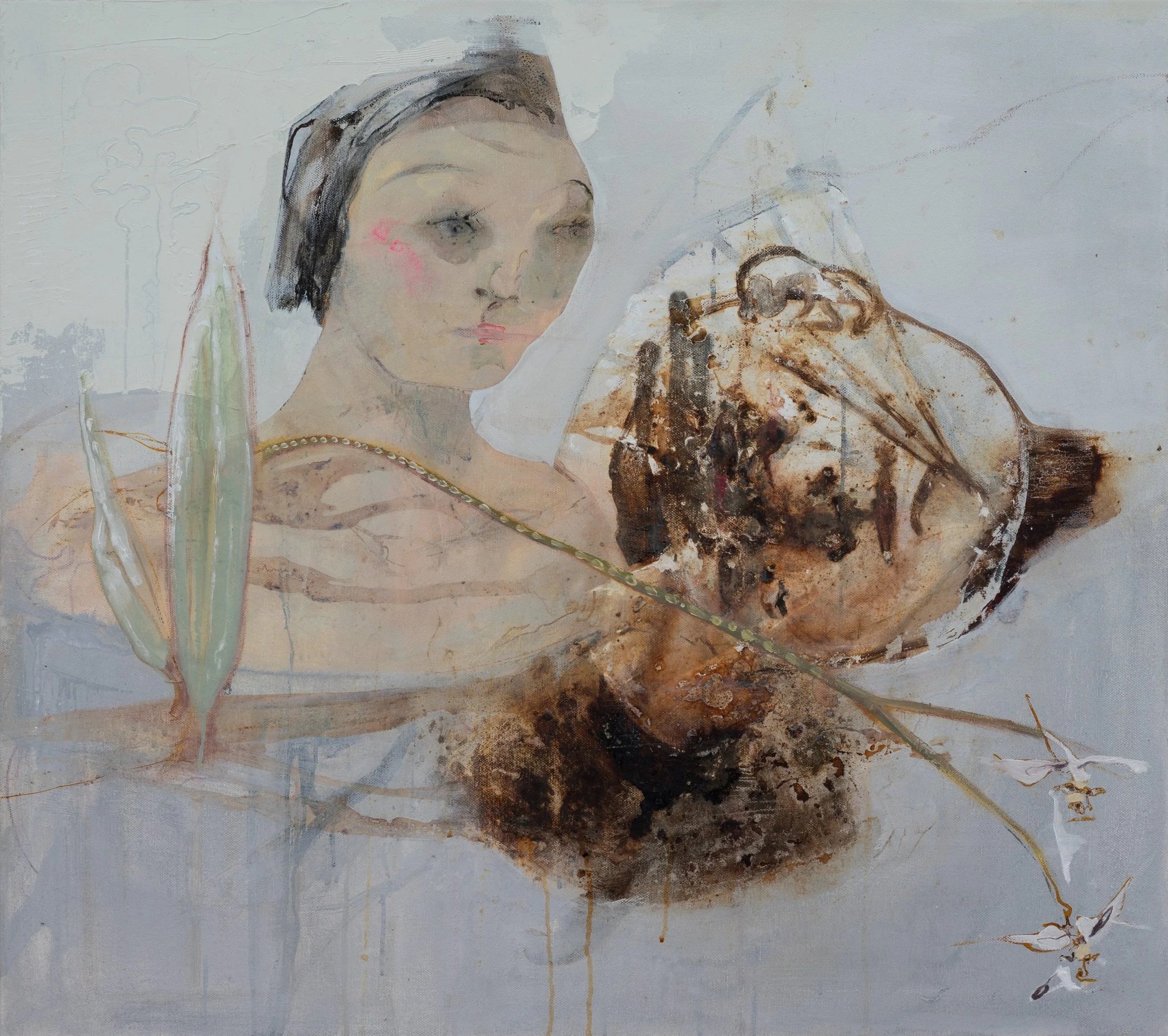
Degenerate Beauty Queen, 2025, Oil on canvas, rust, 95 × 85 cm
Paek has received significant honors: in 2025 she was awarded the BEST GRUPPE annual scholarship; in 2026 she was selected for the Stipendium Junge Kunst and will be in residence at Schloss Styrum.
Recent exhibitions include: the 2025 solo project “SELF EXIT” at NAILS projectroom (NEXUS), Düsseldorf; the group exhibition “Portraits EDEL SEI DER MENSCH” at Braunsfelder, Cologne; the group exhibition “maxiOffset 60 g/m²: Pages of Care” at Kunstverein Bielefeld; the 2022 group exhibition “Bodies of Light and Weight” at Bonian Art Space, Beijing; and the 2020 two-person performance exhibition “Odium Generis Humani” with Elvira Axt at BPA, Cologne. This June, she will present a solo exhibition at Commune Gallery, Vienna.